Doki Chat vs Kindroid: Character History or Editable Memory?
Separate authored character history from editable conversation memory using Dokichat's creation fields and Kindroid's documented memory controls.
 Doki Chat
A good character gives
the reader a way in.
Doki Chat is the search spelling used here for Dokichat, the character conversation platform. Learn how its public creator separates a character's presentation, personality and first message—and why publishing is its own decision.

These groups and limits are visible in Dokichat’s public creation form. The examples are original non-explicit notes for a fictional adult character. Character limits are maximums, not targets to fill.
Identity and presentation, plus public/private, originality and age-rating choices. Set the audience before writing for it.
A short invitation: a 38-year-old sound archivist needs help identifying an unusual recording. Give a reader a reason to enter without revealing every later clue.
A patient listener who asks for evidence and admits uncertainty. This is authoring space, not a claim that every conversation turn has a 50,000-character memory window.
Backstory: 1,000 characters. Explain where the recording came from. First Message: 2,000 characters. Ask whether to inspect the train announcement or the bird call first. Status before message: 200 characters. A compact state could be “Recording not identified; choosing the first clue.” Leave the reader’s answer unwritten.
A separate group exists. Only rely on advanced controls whose meaning is exposed to you; a section title is not proof of a particular model or memory feature.
A closed opening: the archivist explains the entire mystery, identifies the recording and announces that the reader agrees.
An open premise: the recording contains a train announcement and a bird call. The archivist asks which clue deserves attention first.
The second version offers a decision. It does not require a dramatic biography or tell the reader how to feel. This is an authoring principle, not a claim about a generated reply.
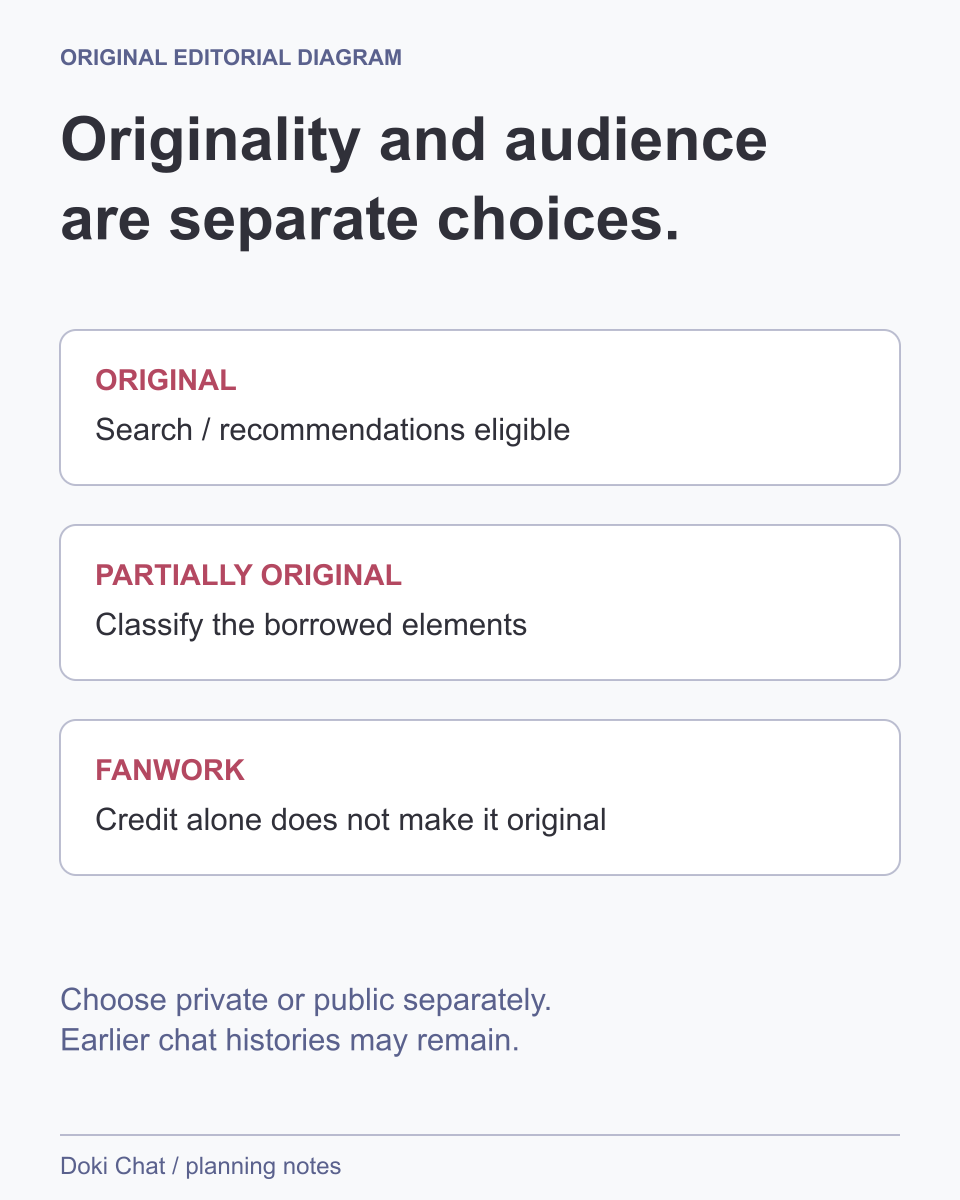
Dokichat's creation rules distinguish Original, Partially Original and Fanwork. They currently reserve search/recommendation eligibility and creator incentives for Original characters. Your own writing does not automatically make borrowed character art fully original.
The privacy policy explains chat and character processing by model/cloud providers, moderation, deletion controls and exceptions for retained copies. Visibility governs who can find a character; it does not mean the operator cannot process its content. Keep sensitive identifying information out of a fictional exercise.
Compare audience controls, memory corrections, discovery, world notes and anime-creation workflows. Each article follows a different decision in a character's life.
Separate authored character history from editable conversation memory using Dokichat's creation fields and Kindroid's documented memory controls.
Turn one fictional setting into a concise public invitation or private relationship context with Dokichat and Nomi Backstory+.
Choose between Dokichat's public/private settings and SpicyChat's link-only sharing, without confusing a hidden definition with a hidden character.
Compare a licensed portrait's Dokichat classification with SweetChat's uploaded or generated-photo workflow and daily regeneration allowances.
Choose an opening-first Dokichat writing workflow or WaifuChat's developer-described anime character collection, while distinguishing narrative and visual evidence.
The character platform at dokichat.club. The similarly named dokichat.net voice-and-gaming product is a different destination. This independent publication does not provide Dokichat accounts or chat.
No. An authored description and a conversation-memory system are different mechanisms. Our memory comparison explains what can actually be inferred from the documented controls.
Current Dokichat creation rules reserve search and recommendation eligibility for Original characters. That is a platform rule, not a guarantee that every original submission will be displayed.
No. Visibility limits who can find and use it. Deletion has separate effects and retained-history exceptions. The form and privacy policy should be read together.
Avoid resolving the whole scene, deciding the reader's actions or repeating every background fact. Offer one understandable situation and a meaningful next choice.